WARNING: This product contains nicotine.
Nicotine is an addictive chemical.
WARNING: This product contains nicotine.
Nicotine is an addictive chemical.
WARNING: This product contains nicotine.
Nicotine is an addictive chemical.
Mint vs Menthol vs Ice E-Liquids: What's the Difference?
Mint vs Menthol vs Ice E-Liquids: What's the Difference?
Descubrimientos
Descubrimientos
por
por
Kareena
Kareena
Learn how mint, menthol and ice e-liquid flavours differ, what creates cooling sensations, and how to understand these flavour profiles.
Learn how mint, menthol and ice e-liquid flavours differ, what creates cooling sensations, and how to understand these flavour profiles.

Mint vs Menthol vs Ice E-Liquids: What's the Difference?
Mint, Menthol and Ice are common terms used to describe e-liquid flavours. Since all three can be associated with a cooling sensation, they are sometimes used interchangeably or mistaken for similar flavour profiles. However, they do not mean exactly the same thing.
In simple terms, Mint describes a mint-based flavour, Menthol refers to a specific compound that also contributes to mint-like flavour and cooling sensations, while Ice is commonly used to describe an added cooling character in an e-liquid.
These terms can overlap in product naming. For example, a Mint e-liquid may also have menthol characteristics, while a Fruit Ice e-liquid can combine a fruity flavour with a cooling effect without necessarily having a distinct mint flavour.
Understanding these differences helps clarify e-liquid flavour descriptions and gives distributors, wholesalers and retailers a better understanding of how different products are positioned.
Mint vs Menthol: What's the Difference?
Mint and Menthol are closely related, but they usually have different meanings when used to describe e-liquid flavours.
What Is Mint E-Liquid?
Mint is generally used to describe e-liquid flavours inspired by the aroma and taste of mint plants.
Common mint profiles include Peppermint, Spearmint, Green Mint and Sweet Mint, each offering a different flavour character.
For example, Peppermint is often associated with a more pronounced menthol-like character, while Spearmint typically has a softer, sweeter and more herbal aroma.
However, Mint is a broad flavour category rather than a standardised formulation. Two e-liquids labelled as Mint may differ considerably in their herbal notes, sweetness, mint aroma and cooling sensation.
What Is Menthol E-Liquid?
Menthol is an organic compound naturally found in certain mint plants. It can also be produced synthetically. Besides its characteristic mint-like aroma, Menthol is known for its cooling sensation.
This cooling effect is related to how the human body senses temperature.
According to the scientific review TRPM8: The Cold and Menthol Receptor, Menthol activates a cold-sensitive receptor known as TRPM8. This receptor is involved in the body's perception of cool temperatures. As a result, Menthol can create a cooling sensation even when the actual temperature has not decreased.
This explains why Menthol is associated not only with mint-like flavour but also with cooling sensations.
In the e-liquid industry, Menthol is also widely used as a flavour descriptor. E-liquids labelled as Menthol typically emphasise menthol-related flavour characteristics and cooling sensations. However, their actual aroma and cooling intensity depend on the specific formulation.
Therefore, Mint and Menthol are not two completely separate or mutually exclusive flavour categories.
The key difference is that Mint primarily describes a broader family of mint-based flavours, while Menthol can refer to a specific compound, its characteristic aroma and its cooling effect.
A Mint e-liquid may contain Menthol, while a Menthol e-liquid may also have a distinct mint flavour profile.
What Does Ice Mean in E-Liquid Flavours?
Unlike Mint and Menthol, Ice serves a slightly different purpose in e-liquid product naming.
In modern e-liquid terminology, Ice is commonly used to describe an added cooling character rather than a distinct flavour with a fixed aroma.
For example:
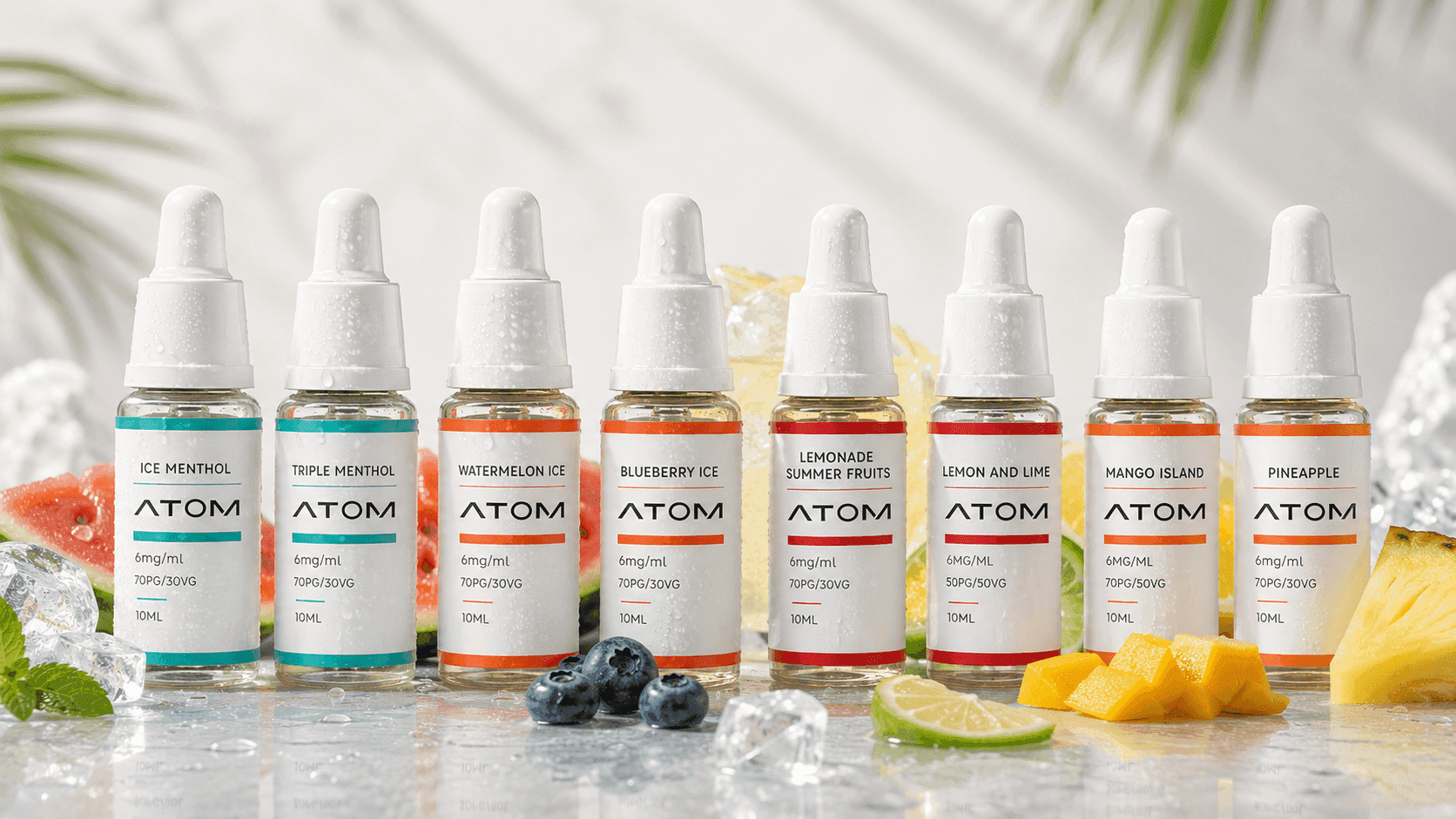
Watermelon Ice: Typically combines a watermelon flavour with a cooling sensation.
Blueberry Ice: Combines a blueberry flavour with a cooling character.
Mint Ice: Combines a mint flavour with additional cooling.
In these examples, Ice highlights the cooling character of the product, while the underlying flavour may come from fruit, mint or other flavour profiles.
This is why Ice can be combined with a wide range of flavours rather than being limited to Mint or Menthol products.
Does Ice E-Liquid Always Contain Menthol?
No. Menthol can produce a cooling sensation, but it is not the only ingredient used to create cooling effects in e-liquids.
Other cooling agents, such as WS-23 and WS-3, are also used in the industry. These compounds can produce cooling sensations without necessarily creating the same mint-like aroma associated with Menthol.
For example, a Fruit Ice e-liquid may have a fruity flavour as its main characteristic, combined with cooling agents to create an icy finish without a distinct Menthol flavour.
However, Ice is not a standardised formulation term. Seeing Ice in a product name does not confirm which cooling agent has been used or how strong the cooling sensation will be.
For a closer look at Menthol, WS-23 and other cooling ingredients, read ATOM's E-Liquid Additives Explained.
Mint, Menthol and Ice: Comparing Flavour and Cooling Characteristics
Although these three terms frequently appear across cooling e-liquid ranges, they describe different characteristics.
Comparison | Mint | Menthol | Ice |
|---|---|---|---|
Primary meaning | Mint-based flavour description | Compound, flavour characteristic and cooling effect | Cooling descriptor |
Typical sensory profile | Mint aroma, herbal notes and possible sweetness | Menthol-like aroma and cooling sensation | Cooling character added to an underlying flavour |
Cooling intensity | Depends on the formulation | Depends on the formulation | Depends on the formulation |
Common product names | Mint, Spearmint, Green Mint | Menthol, Double Menthol | Watermelon Ice, Ice Mint |
Main focus | Type of mint flavour | Menthol character and cooling | Additional cooling character |
It is important to understand that there is no universal cooling intensity ranking between Mint, Menthol and Ice.
Ice is not necessarily cooler than Menthol, and Mint does not automatically mean a milder cooling sensation. The actual experience can vary depending on the flavour combination, cooling ingredients and formulation.
These terms are therefore best understood as flavour and product descriptors rather than fixed indicators of cooling intensity.
What Do These Differences Mean for E-Liquid Retailers and Distributors?
For distributors, wholesalers, retailers and vape shops, understanding the differences between Mint, Menthol and Ice can help with both product positioning and range organisation.
1. Clearer Product Positioning
These terms help indicate what a customer is likely to expect from a product. Mint usually suggests a mint-led flavour profile, Menthol often points to menthol-related flavour and cooling, while Ice typically signals an added cooling finish layered onto another flavour.
However, two products with similar names may still differ in aroma, sweetness or cooling intensity, so product descriptions and sample evaluation remain important. For further guidance on assessing products, read ATOM's E-Liquid Sample Evaluation Guide.
2. Better Range Organisation
Understanding these differences can also help buyers organise a cooling category more clearly. Instead of treating every cooling product as the same type of flavour, it is more useful to distinguish between mint-focused profiles, menthol-led profiles and fruit flavours with an icy finish.
This can make product ranges easier to compare, describe and present, especially when reviewing multiple SKUs for retail or distribution.
Explore ATOM's Cooling E-Liquid Range
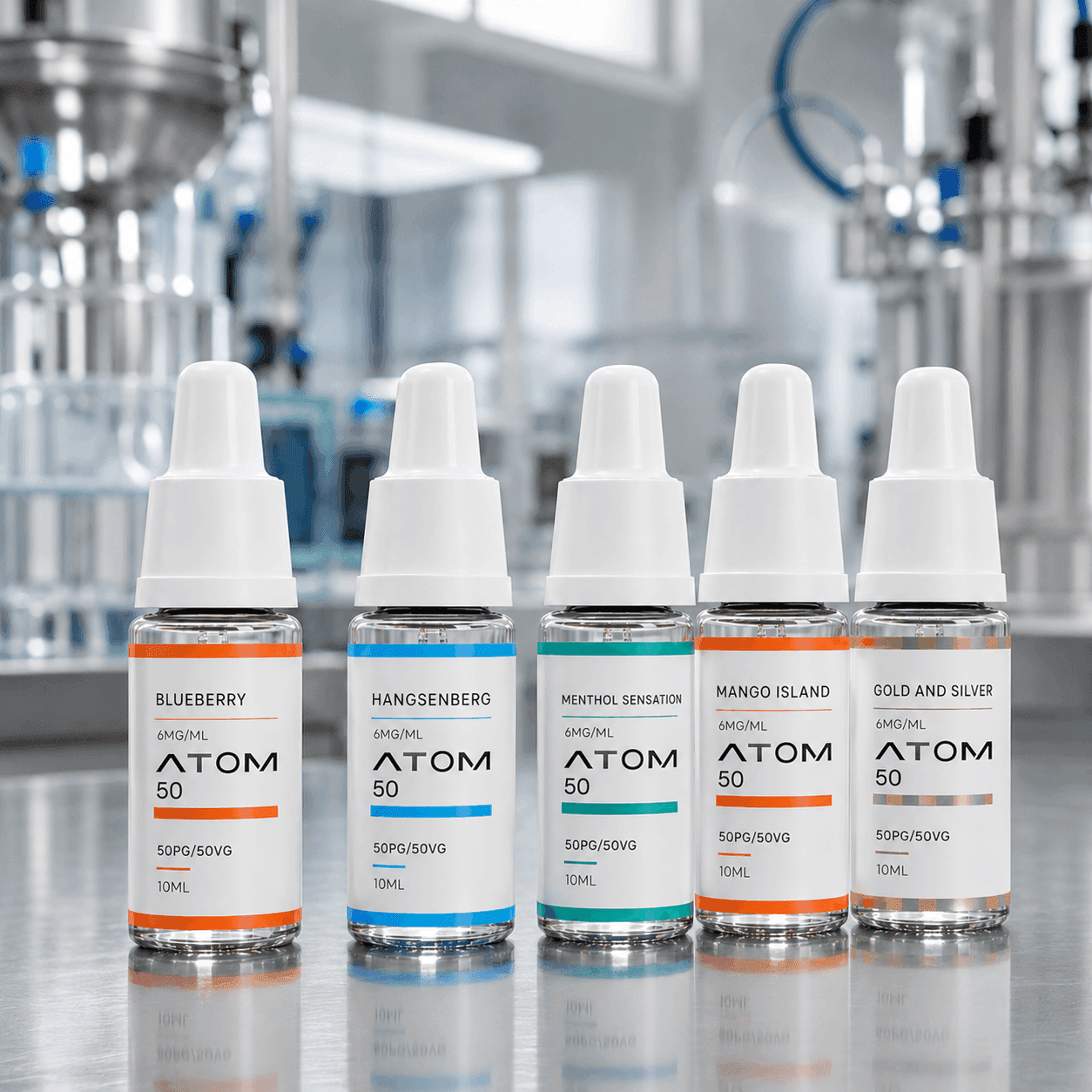
ATOM offers a range of branded 10ml freebase e-liquids featuring mint and menthol flavour profiles, distributors, wholesalers and retailers can explore ATOM's Cooling E-Liquid Range to discover more products or contact our team for product information and samples.
Frequently Asked Questions
Is Ice E-Liquid Always Cooler Than Menthol E-Liquid?
No. Ice generally indicates a cooling character, but it is not a standardised measure of cooling intensity. Menthol can also produce a pronounced cooling sensation. The actual cooling experience depends on the formulation and product characteristics.
Does Fruit Ice E-Liquid Always Have a Mint Flavour?
No. Fruit Ice generally describes a combination of fruit flavour and cooling character. Some products may use ingredients that create a mint-like aroma, while others may use different cooling agents without a distinct mint flavour.
Conclusion
Mint, Menthol and Ice may appear similar in e-liquid naming, but they do not describe exactly the same thing. Understanding how these terms are used can help retailers and distributors interpret product descriptions more accurately and compare cooling flavour profiles more effectively.
For B2B buyers, this makes it easier to review product ranges, organise flavour categories and identify options that fit different market needs.
Compartir artículo
Compartir artículo
CONTINUE READING
CONTINUE READING




Copyright © 2026 ATOM. All rights reserved.
Copyright © 2026 ATOM. All rights reserved.